
News
Stay up to date on the latest crypto trends with our expert, in-depth coverage.

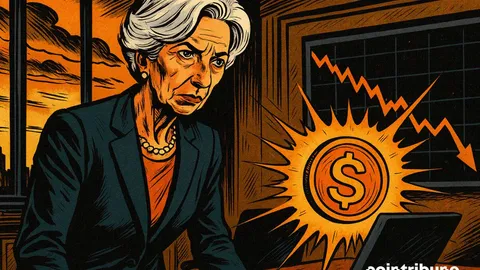
Christine Lagarde Warns Against The Adoption Of Stablecoins
Cointribune·2025/07/07 08:30

XRP Tests Key $2.33 Resistance Amid Rising Market Hopes
·2025/07/07 08:30
Bank of Canada Trials Digital Dollar with OpenCBDC
·2025/07/07 08:05
Metaplanet Buys 2,205 BTC, Now Holds 15,555
·2025/07/07 08:05
Understanding Stablecoin Attestations & Reserves
·2025/07/07 08:05
Bitcoin Volatility Drops: $150K in Q3, $250K in Q4?
·2025/07/07 08:05
DOGE Eyes Breakout as Support Holds Firm
·2025/07/07 08:05
Ethereum Tokenized AUM Hits $5B Milestone
·2025/07/07 08:05
Whale Buys 1.9K ETH and Stakes $4.87M
·2025/07/07 08:05
3 Altcoins That Could Hit All-Time Highs In The Second Week Of July
·2025/07/07 08:00
Flash
10:15
Bitunix Analyst: Market Starts Trading Peace Dividend, but the Truly Revalued are Global Funding Cost and Liquidity OrderBlockBeats News, June 16th. The market focus has gradually shifted from the Middle East conflict itself to the fund reallocation after the peace agreement. As Trump arrives in Europe to attend the G7 summit, both the US and Iran have simultaneously confirmed that they will sign a memorandum of understanding on the 19th, and the process of reopening the Hormuz Strait continues to advance. However, from the stance of Mitsui O.S.K. Lines, the world's largest oil tanker operator, it is clear that the market is no longer concerned about whether the agreement will be signed, but whether shipping, insurance, and the energy supply chain can return to normal operations. This is also the core reason why oil prices have fallen recently, the stock market has risen, but shipping companies remain cautious—risk events are receding, but the risk premium has not yet completely disappeared.
From a macro perspective, the global market is simultaneously facing three intersecting capital trends. The first is the inflation expectation adjustment brought about by the decrease in energy risk. If the US-Iran agreement is smoothly implemented, it will help lower energy prices and transportation costs. The second is the divergence in major central bank policies. The Bank of Japan raised interest rates to a 31-year high but simultaneously announced that it would stop further reducing its bond purchases, essentially still controlling bond market volatility. The third is the imminent first FOMC meeting under Fed Chair Powell, with the market's initial expectations of a rate cut narrative quickly shifting to "maintaining high rates for longer," and even starting to discuss the possibility of a rate hike. In other words, what the market is trading is no longer loose liquidity but the repricing of global funding costs.
It is worth noting that the capital markets have not shown obvious risk aversion as a result. SpaceX's IPO fundraising scale has expanded to $85.7 billion, NVIDIA has once again issued up to $20 billion in investment-grade bonds, and BlackRock has pointed out that about $8 to $9 trillion is flowing from money market funds back into risk assets. This indicates that the market is not lacking liquidity but that liquidity is seeking new allocation directions. As a large amount of funds flow into AI, the space industry, and large tech companies, market valuation risks are also accumulating. A recent survey of economists shows that over 70% of respondents believe that the probability of a 20% or more pullback in US stocks in the next year is higher than the historical norm, reflecting that the market is starting to pay attention to the disconnect between asset prices and fundamentals.
For the crypto market, this is a typical stage dominated by liquidity and risk appetite. The peace agreement, the fall in oil prices, and the re-entry of funds are beneficial for improving overall risk sentiment. However, if Powell releases signals more inclined towards controlling inflation or reducing the balance sheet during this week's FOMC, the market may still readjust its expectations for future liquidity. In addition, SpaceX's stock options debut, the arrival of Triple Witching Day, and the S&P 500 quarterly rebalancing all indicate that global market volatility may significantly increase this week. In this environment, BTC's most important role is not as a leading asset but as an indicator of whether global funds are willing to continue bearing risk. In the short term, the market is trading on the peace dividend, but what the market truly needs to verify in the medium to long term is whether asset valuations in a high-interest-rate environment can be supported by real profits and cash flow.
10:10
HIP-3 US Stock Gainers: SPCX Leads Gains, Storage Semiconductor Sector Shows StrengthBlockBeats News, June 16th. According to Hyperinsight Monitoring, as of June 16th, 18:00, in the Hyperliquid HIP-3 US stock market, SPCX (SpaceX) led the gains with a 12-hour increase of 7.25%, reaching a current price of $211.39. The 24-hour trading volume reached $1.129 billion.
Four of the top five spots are from the storage and chip sector: WDC (Western Digital) with a 12-hour increase of 5.20% ranked second; MU (Micron Technology) with a 12-hour increase of 3.34% and a pre-market increase of 3.62%, leading the pre-market session; the DRAM spot index rose by 1.98%; SKHX (SK Hynix) rose by 1.77%, showing overall strength in the storage industry chain.
09:57
SoftBank Partners with OpenAI to Launch AI Cybersecurity Service in Japan, Masayoshi Son Warns AI Attacks Could Lead to Japan's "Black Ship Crisis"BlockBeats News, June 16th. SoftBank Group announced on Tuesday that it will launch an AI-driven cybersecurity service for Japanese enterprises, aiming to meet the growing market demand for AI defense capabilities. The launch event took place on June 16th in Tokyo, where SoftBank Group CEO Masayoshi Son attended and delivered a speech.
At the event, Son warned that AI-driven cyber attacks could become Japan's "Black Ship Crisis" moment — referring to the historical event in the 19th century when American warships arrived to demand the opening of Japan's borders, implying that AI cyber threats could have a similarly disruptive impact on Japan.
The launch of this service comes at a time when the U.S. is restricting foreign expansion of competing AI models, and SoftBank's move is seen by observers as a strategic step to accelerate its presence in the Japanese AI security market amid a backdrop of geopolitical tech competition.
News